
Landscaping in Hellstrips and Riverbeds
- Nate Venarske

- Jul 14, 2020
- 4 min read
Updated: Jul 15, 2020

From my experience, every yard has at least one "problem spot." Whether it's that patch of grass between the sidewalk and the street (appropriately called a Hellstrip) or that barren expanse of cracked clay underneath a black walnut, there's always a place where the grass withers away and the boxwoods give up the ghost.
The same is true for businesses and even neighborhoods. The tried-and-true method is to repeatedly re-sod the area, or replant the plants that died previously. At Mississippi State University last semester, I watched for a few weeks as a stand of Leland Cypress fried to a crisp under the combined attack of ultraviolet radiation and Passalora Needle Blight. PNB is caused by plants being too close together. If you use Leland Cypress as a hedge--the only use for which it is marketed--you will inevitably end up with a bunch of dead trees. (I know from experience.)

They replanted the exact same number of the same species in the same positions. I didn't know whether to laugh or cry.
It's always baffled me why the go-to solution for hedges in Mississippi is a hybrid of an Alaskan and a Californian species. The obvious solution is to use plants that were designed for the habitat, instead of, I don't know, using plants from Alaska. But I digress.
Last night my mom was on a Zoom meeting with our Homeowners' Association. I was lounging in my room across the house when I heard one word: Liriope. Instantly, I sprang into action, tearing my earphones from my ears and barreling down the hallway. Snippets of context reverberated into my brain: "shade," "it has done well in our yard," "what about jasmine?" I skidded to a halt in the kitchen and yelled, in what probably came across as an obnoxious tone, "Liriope and jasmine are invasive!"
"Well," my mother suggested, "why don't you go make a list of plants you like that would do well in that spot."
I didn't need clarification. I knew exactly what "that spot" was. Deep shade, bare soil, floods like a river when it sprinkles but dries to the bones in the summer. Almost every other part of our neighborhood is beautifully (if non-natively) landscaped, and this patch of dirt stands out like a Tallow in a tomato garden.

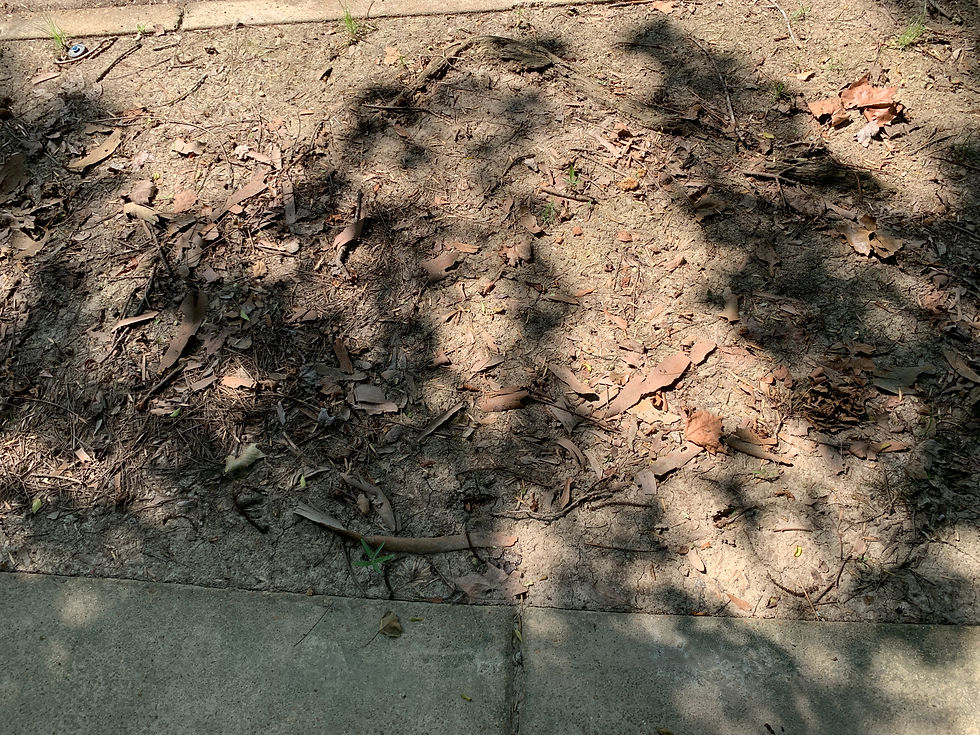
This morning, I strolled over and tried to get a feel for the soil and existing vegetation, and I'm quite pleased. The issue certainly won't be finding plants that will thrive there; on the contrary, there are almost too many options to choose from.
Here's my abbreviated list.
(My mommy told me to include common names, which I have done in parentheses.)
Site Conditions: Bare loam, floods Spring and Fall, dries in summer, shade, Quercus (oaks) and Acer (maples) overhead, Triadica sebifera (Chinese tallow) invading.
Landscaping Goal: Evergreen ground cover with several months of blooms.
Plant Characteristics: Drought and flood tolerant, shade, erosion control, water sequestration to reduce runoff.
Candidate Plants (a few of many possibilities):
Evergreen groundcovers:
Dryopteris x australis (Dixiewood fern)
Carex pennsylvanica (Pennsylvania sedge)
Carex stricta (tussock sedge)
Flowering Plants:
Spring: Tradescantia ohiensis (bluejacket), Iris cristata (dwarf crested iris), Hydrangea quericifolia (oakleaf hydrangea).
Summer: Lobelia cardinalis (cardinal flower), L. siphilitica (great blue lobelia), Ruellia caroliniensis (carolina petunia)
Fall: Chelone glabra (white turtlehead), Solidago caesia (blue stemmed goldenrod).
Foliage Plants
Onoclea sensibilis (sensitive fern)
Athyrium felix-femina (lady fern)
Chasmanthium latifolium (inland sea-oats)
Carex cherokeensis (cherokee sedge)
Carex texensis (texas sedge)
Carex rosea (rosy sedge)
I don't have good pictures of most of the above plants, but here's a sampling.





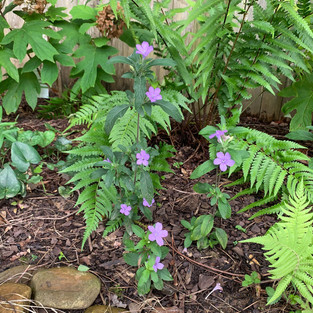

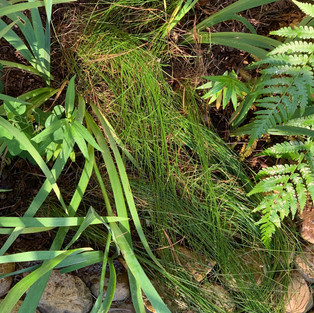





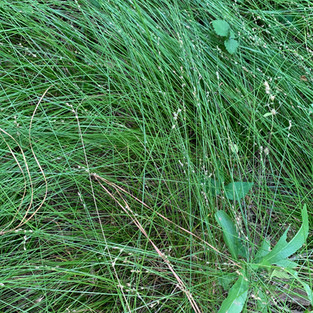
First Row (L to R): Sensitive fern, Lady fern, bluejacket.
Second Row (L to R): Carolina petunia, Irises mingled with Texas sedge, Inland sea-oats
Third Row (L to R): Cherokee sedge, Iris, Texas sedge.
There are a couple of caveats with the site. First, maple roots are notoriously difficult to landscape around. Sowing seeds may be both more cost effective and provide better results, although the whole "floods every time it rains" shenanigan might work against that end.
Second, the site drains into a small gully that is on private property. Therefore, it would be extremely unethical to use weedy plants, especially invasive exotics like the invasive paleyellow iris and Asiatic jasmine that destroy native ecosystems and potentially decrease property value (as in the case of Kudzu, which is actually a mild invasive compared to garden staples such as Lantana and non-native honeysuckles).
Unfortunately, native plants are difficult to come by in Mississippi, especially in the bulk required for this project. Landscapers also overcharge a lot and will intentionally install plants that are less than equipped for your site. (It's difficult to conduct a meaningful survey to ask landscapers "how much do you cheat your customers," so the only way to get a handle on this is the word of experts in the field: check out this article.) Also, most landscapers would want to "amend" the soil. You can see why that's a waste of your money here. If they can't find plants that will fit the site, they should be back at school.
My advice to the neighborhood association: you can do this really cheaply by buying seeds for under $50 (Prairie Moon Nursery has the best selection and doesn't sneak weeds in there like American Meadows and others do).
Also, some wholesale nurseries sell wholesale volumes at wholesale prices to individuals. Look up Tennessee Wholesale Nursery, where you can expect $.89 per plant for quantities over 100. Considering that plants like Dryopteris x australis take up around 4 sq. feet when mature, you're looking at 23 cents per square foot. In my zip code, lawn costs between 21-26 cents per square foot, and installation costs bring the total closer to $.92-1.33 for every square foot. For something that you'll never need to mow or spray, that's quite a bargain.

Signing out,
NOV


Were you really singing when you signed out? Nice job on the post, son!